
Fluid Power and Hydraulics Market - 2026 Challenges
By mid‑2025, we published an in‑depth analysis of the Italian and global hydraulics, and the broader fluid power market.
If you missed it, you can catch up at this link.
Up to that point, the results pointed to a stabilization phase following the 2024 order downturn, with a few early signs of a technical recovery.
But what does year‑end really look like?
Today, with the full‑year data in hand, we see a more nuanced picture: there are encouraging elements, but also dynamics that call for a critical and realistic assessment.
Real Growth, New Limits: The 2013–2025 Landscape
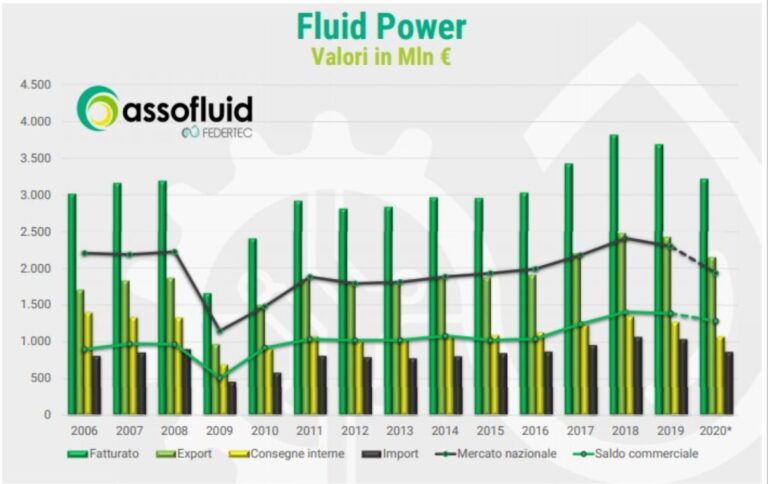
Ten‑Year Trajectory Remains Positive: between 2013 and 2023, Italy’s fluid power sector expanded meaningfully, with solid gains in revenue and exports.
However, final 2025 results confirm a contraction versus the year‑start forecast, with total revenue landing around €4.7–4.8 billion, slightly below July estimates.
Macro figures for industrial valves and taps, an adjacent segment to fluid power, show that in 2024 revenue exceeded €9.5 billion, with exports accounting for 63% of sales, and foreign sales up +4.6% in H1 2025 to markets such as the U.S., Germany, and Saudi Arabia.
Taken together, this underscores the international competitiveness of related industrial component categories.
Orders & Volumes: Gradual Pick‑Up, Unevenly Distributed
In 2024, order intake fell by more than 20%, driven primarily by exports.
Across full‑year 2025, bookings showed a modest rebound (+5% to +6%), but in many verticals they remain below pre‑downturn levels.
This confirms the recovery is underway—but still fragile.
On the shipments/deliveries side, several component categories, particularly core hydraulic products like pumps and cylinders, are exhibiting more resilient global demand, with meaningful growth expected over the next few years.
For example, the global hydraulic pumps market is projected to reach $13.7 billion by 2030, while hydraulic cylinders are forecast to exceed $21 billion over the same period.
Polarization and Innovation: The Global Fluid Power Market
The global context points to moderate yet steady growth across the more advanced segments of hydraulics and fluid power.
Market estimates indicate:
- The global hydraulic equipment market is expected to remain in expansion over the medium term, with a CAGR of roughly 4–5% through 2030.
- Asia–Pacific and North America continue to show greater dynamism compared with Western Europe.
- The integration of digital technologies and condition monitoring (including IoT‑based sensing) is becoming a critical source of competitive differentiation.
It’s important to note that not every component category is growing at the same pace.
Segments such as sustainable hydraulic fluids show targeted growth prospects, propelled by environmental regulation and customer preference for sustainability.
Innovation and Transformation: Not Just Growth
2025 confirmed that the sector’s technology transition is not strictly linear.
The main innovation drivers—advanced sensing, predictive maintenance, and digitally integrated systems—are gaining traction, but adoption speed varies widely across companies:
- Leading players are establishing themselves in high‑performance segments thanks to sustained IoT and digitalization investments.
- Other organizations—especially traditional SMEs—are struggling to effectively integrate digital technology into their systems.
In addition, industry initiatives such as the NFPA Industrial Technology Task Force, focused on industrial fluid‑power technology needs, underscore the growing importance of collaboration between industry and development centers to tackle common challenges in mature markets.
2026 Outlook: Stabilization Ahead, Priority Realignment
Updated forecasts indicate that in 2026 the sector could return to moderate growth (around +2%), driven by specific end‑markets such as agricultural machinery and construction, where the adoption of smart technologies is more pronounced.
However:
- The recovery is moderate and uneven across segments and regions;
- The technology gap within the supply chain may widen unless companies invest in digital skills and data analytics;
- Emerging markets and non‑EU regions remain the primary engines of export.
The challenge for 2025–2026 is not only to return to pre‑downturn levels, but to evolve toward higher value‑added solutions in which fluid power and digitalization are integrated more tightly and systematically.
Key sources (updated December 2025)
- La Repubblica — “Italian Valves and Taps: Revenue and Exports 2024–2025,” October 24, 2025
- Grand View Research — Hydraulic Pumps Market Size & Growth (2025–2030)
- Grand View Research — Hydraulic Cylinder Market Forecast (2025–2030)
- Mordor Intelligence — Hydraulic & Fluid Power Equipment Market Overview 2025
- Market Research Future — Hydraulic Fluid Market Trends (sustainability and regulatory drivers)
- NFPA — Industrial Technology Roadmap Update 2025 (fluid power capabilities and industrial technology drivers)
SmartFluidPower is an innovative SME founded in 2018 as a spin‑off of the University of Modena and Reggio Emilia.
Our academic background—combined with the R&D engagements entrusted to us by companies across the fluid‑power supply chain (especially in Emilia‑Romagna, a well‑known industrial cluster)—has enabled us to understand the needs and pain points of manufacturers of hydraulic components and systems.
Too often, when teams approach dynamic simulation, they run into complex, generic, high‑cost software—of which they end up using perhaps 10%.
We set out to change that.
We deliver tailored solutions designed to simplify simulation, digitize your products, and help you save time and materials while optimizing performance.
See whether SmartFluidPower is the right fit for your company
With our intuitive, scalable simulation software, you can virtually model hydraulic components, with no limit on configurations to test.
From day one, you’ll be supported by our specialized technical team, providing the know‑how your engineering department needs to tackle future challenges.
With dynamic simulation, you can visualize fluid behavior within your component or system, and how it interacts with all other elements.
If you’re struggling with a critical component, this approach may be exactly what you need.
Training for companies (modular tailored to user level):
- Hydraulics
- Modeling and simulation
- Interface creation