
“FROM SIMULATION TO OPTIMIZATION: MAXIMIZING PERFORMANCE AND ENERGY EFFICIENCY”
PART 4
Why energy efficiency in hydraulic systems is critical today
In the fluid power sector, a machine’s competitiveness is no longer determined solely by its ability to generate force or motion.
Today, parameters such as energy efficiency, cycle time, thermal dissipation, operating costs, and speed of project development have become central.
In this context, hydraulic dynamic simulation represents a strategic tool for designing higher‑performance systems before physical prototyping.
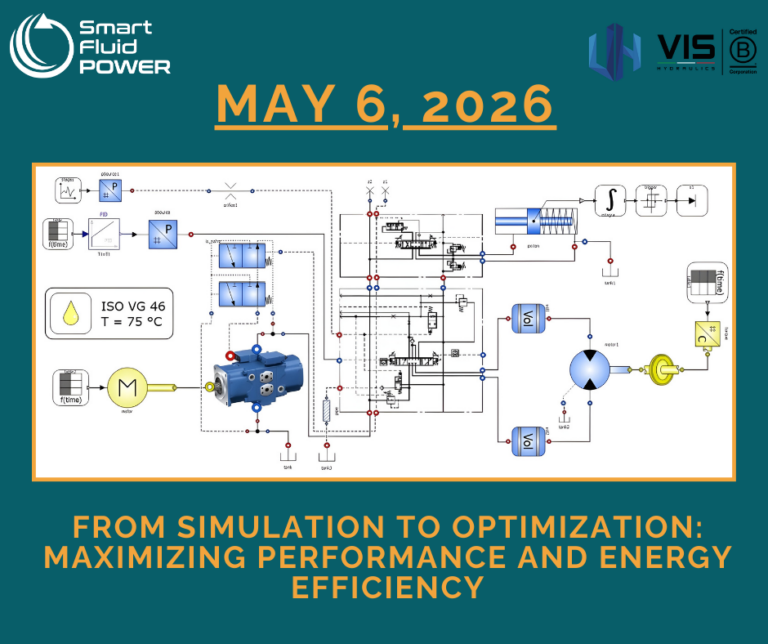
During this session, a real-world case study of energy optimization for a Load Sensing (LS) circuit, developed in the OpenModelica environment, was presented.
Optimizing the Energy Efficiency of Hydraulic Systems Through Dynamic Simulation
Modern hydraulic systems integrate variable‑displacement pumps, load‑sensing directional valves, accumulators, control logics, and actuators subjected to variable dynamic loads. In such systems, traditional static calculations are no longer sufficient to accurately predict real operating behavior.
Lumped‑parameter dynamic simulation makes it possible to analyze the dynamic interaction among all system components, enabling rigorous evaluation of pressures, flow rates, energy losses, and overall efficiency throughout the entire operating cycle. This approach significantly reduces development time and minimizes design errors.
During the webinar, a circuit was analyzed consisting of a load‑sensing‑controlled variable‑displacement pump and three linear actuators operating under different load conditions.
The first actuator was characterized by a high flow demand, while the other two followed predefined duty cycles described through position–load curves.

Energy efficiency analysis of a load‑sensing system
One of the most relevant aspects of simulation is the ability to measure the real efficiency of the system.
In the model developed during the webinar, the power absorbed by the electric motor, the total energy supplied to the circuit, and the useful power delivered to the actuators were all calculated.
The mechanical power at the motor shaft was obtained using the relation:
P=T⋅ωP=T⋅𝜔
while the total energy was computed by integrating power over time:
E=∫P dtE=∫P dt
Thanks to the simulation, it was possible to observe that the traditional circuit exhibited significant energy dissipation during certain phases of the duty cycle, particularly during actuator retraction, when the pump continued to generate flow despite reduced load demands.
As a result, the overall system efficiency was found to be approximately 43%.

Energy Optimization of a Hydraulic System with a Hydraulic Accumulator
To improve system performance, a second system architecture was introduced, incorporating a hydraulic accumulator and a dedicated charge/discharge control logic. The goal was to support the pump during peak demand from the first actuator, while at the same time reducing the pump’s displacement.
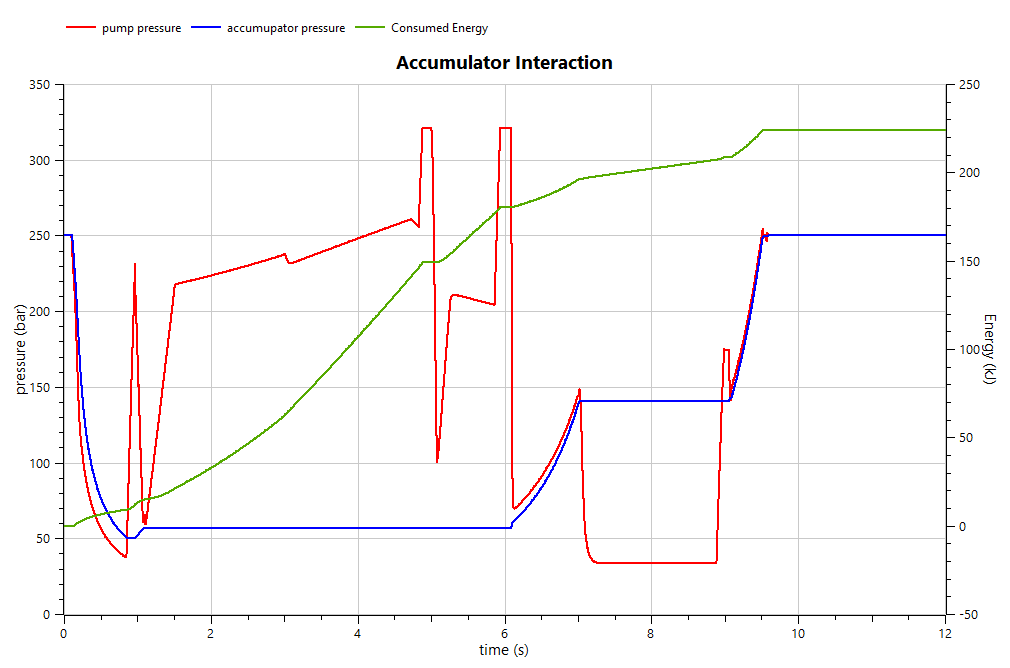
In the optimized model, the pump was downsized from 100 cc to 66 cc, while the accumulator was pre‑charged and managed through logic valves controlled by the system’s load‑sensing signals.
The simulation showed that the accumulator was able to supply additional flow during the most demanding phases of the duty cycle, allowing faster motion of the first cylinder and a reduction in overall cycle times.
Thanks to simulation, we were able to verify that the optimized system maintained the same functional performance as the original circuit, while delivering faster response times thanks to the accumulator’s support during peak flow demand. This made it possible to reduce the cycle time of the most critical actuators while using a smaller variable‑displacement pump, downsized from 100 cc to 66 cc.
In addition to improved dynamic behavior and an increase in overall efficiency to approximately 45%, pump downsizing also delivers a concrete economic benefit, reducing the cost of the power unit without compromising system performance.
Parametric Simulations and Data‑Driven Design
One of the most advanced advantages of the approach presented during the webinar lies in the ability to run automated batch simulations. By varying parameters such as accumulator volume, pre‑charge pressure, or pump sizing, it becomes possible to quickly compare dozens of different configurations and identify the optimal operating point.

In the case study, it was shown that an alternative accumulator configuration—although seemingly beneficial—actually led to a reduction in overall system efficiency.
This highlights how risky it can be to rely solely on empirical experience without proper virtual validation.
The Concrete Benefits of Hydraulic Simulation
The introduction of dynamic hydraulic simulation into company workflows makes it possible to:
- reduce physical prototyping
- optimize energy consumption and dissipation
- validate advanced control strategies
- accelerate product development
- reduce design risk
Thanks to the libraries developed by SmartFluidPower for OpenModelica, it is possible to build modular models of pumps, directional valves, actuators, accumulators, and complete fluid power systems using an intuitive graphical drag‑and‑drop approach.
This also enables technical teams without a software‑development background to integrate advanced simulation into their design workflows.
Key Takeaways
Dynamic simulation has become an essential tool for developing hydraulic systems that are more efficient, faster, and more competitive.
The case study presented during the webinar demonstrates how it is possible to improve the performance of a load‑sensing circuit, downsize system components, and increase energy efficiency through accurate virtual validation.
The integration of OpenModelica with SmartFluidPower’s libraries enables companies in the fluid power sector to adopt advanced design methodologies, turning simulation into a true accelerator of innovation.
Watch the webinar recording
Was this useful for your work? Let us know!
Take the 2‑minute questionnaire and get access to additional resources.
Don’t miss the final webinar in the series!
A practical journey on how to introduce dynamic simulation into design workflows, starting from a simple model—without disrupting the existing organization.
