Why it’s important to simulate pressure losses in hydraulic manifolds
In modern fluid power systems, manifolds (or valve blocks) play a crucial role.
The growing trend toward increasingly compact circuits leads to complex internal geometries, with tight bends, intersections, and sudden changes in cross‑section. While this helps save space, it also introduces significant pressure losses which—if not properly accounted for—can compromise the efficiency and performance of the entire hydraulic system.
Traditionally, analyzing these flows requires complex CFD (Computational Fluid Dynamics) simulations or costly physical testing.
But what happens when you need to quickly simulate an entire vehicle or machine, without losing physical consistency in pressure losses—which directly affect efficiency, sizing, and the dynamic behavior of the system?
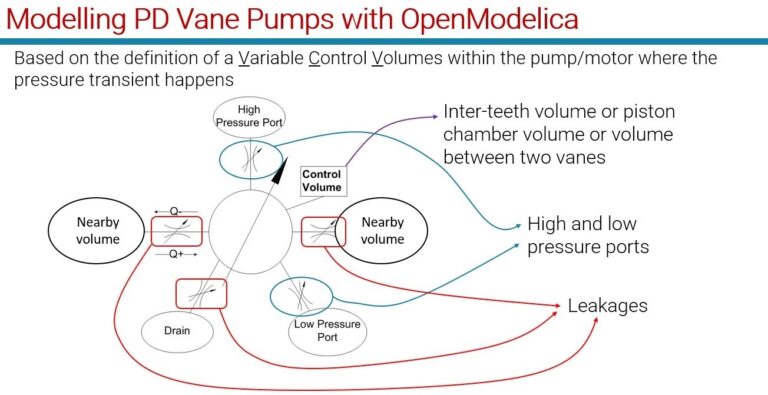
Our solution: a new OpenModelica library currently under development
To address the need for fast yet accurate system‑level (0D) simulations, our engineering team is currently in advanced stages of developing a new dedicated OpenModelica library, specifically designed to model pressure losses in the complex internal flow paths of hydraulic manifolds.
At the mathematical core of this new tool lies the well‑known reference Handbook of Hydraulic Resistance by I. E. Idelchik, complemented by additional advanced formulations drawn from recent scientific literature. We are translating these sophisticated empirical correlations into agile, ready‑to‑use software components tailored for system‑level simulation workflows.
Model validation workflow
From the very beginning, we knew that simply implementing the formulas would not be enough.
The internal architecture of real manifolds often features combinations of geometries that classical references struggle to cover individually.
For this reason, we are subjecting our library to a rigorous three‑level cross‑validation process:
- 1D modeling (OpenModelica): the new tool currently under testing.
- 3D analysis (CFD): to gain a detailed understanding of fluid‑dynamic behavior.
- Experimental testing: measurements performed on the test bench using physical manifolds.
The Comparison: From Theory to Practice
To ensure the quality of the validation process, we built a dedicated test bench specifically designed to measure pressure losses in real hydraulic manifolds.
The experimental setup allows precise control of the flow rate and enables pressure data to be acquired along the internal flow path, making it possible to directly compare real behavior with simulation results.
The manifold was then tested under different operating conditions, measuring the pressure drop as a function of flow rate.
To gain a detailed understanding of local fluid‑dynamic phenomena, we complemented the experimental tests with **CFD analyses** on representative geometries, such as an internal elbow within the manifold. These simulations make it possible to visualize velocity and pressure distributions inside the channels, highlighting effects such as flow separation, recirculation zones, and local gradients that cannot be directly captured by simplified models.
In parallel, we developed the equivalent model in the OpenModelica environment, using the library currently under development to represent the internal flow path of the manifold.
The goal is not to replicate the local level of detail provided by CFD, but rather to consistently capture the global effect of pressure losses within a system‑level simulation. The model therefore makes it possible to quickly analyze system behavior as operating conditions change.
Finally, we compared the results obtained from the three approaches: experimental testing, CFD analysis, and the 0D model.
The data analysis shows some deviations in the pointwise values, but also a good ability of the 0D model to capture the overall trend of the phenomenon as operating conditions change.
In particular, the model consistently reproduces the evolution of pressure losses with varying flow rate—an aspect that is essential for use in system‑level simulations.
Since the library is still under development, these preliminary results are encouraging: the team is actively working to further improve both the correlations and the predictive capability of the model.
While CFD simulations require significant computational time for each operating point, the OpenModelica model delivers results in dramatically shorter computation times, making it possible to analyze multiple scenarios efficiently during the design phase.
Conclusions and Next Steps: Coming in Future Releases
This approach makes it possible to bring pressure‑loss evaluation directly into system‑level simulation, reducing reliance on CFD iterations and physical testing during the early stages of design.
At present, the module is undergoing active development and internal validation.
Our team continues to map new geometries, complex intersections, and to expand the component database.
We are excited to announce that the entire library will be officially released and made available to all our users in future versions of our software.