Mechanical
⚙️ Mechanical library
The heart of this library consists of mass/inertia elements. The forces generated along the entire kinematic line are summed from block to block and transmitted to the mass/inertia, which, through the fundamental F = m*a calculate the dynamics of the component.
Each kinematic line must be connected to at least one position source:
- for the translational library: a mass, a
VelocitySource, aDisplacementSourceor aZeroSpeed - for the rotational library: an inertia or
AngSpeedSource
Elements that can have relative movement between their pins, for example springs, dampers, contacts, etc..., break the stiffness: each pin has an independent kinematics and must be connected accordingly to a position source. (1)
-
these components are identifiable because a
directionparameter is associated with each pin, likedirection1anddirection2(1)- the only exception is the
Dampermodel, which does not need this identification (however it interrupts the kinematic line)
- the only exception is the
Unlike the Hydraulic Library, in this library it is possible to have multiple connections on the same pin. The Force variable (through) is summed to be transmitted to the mass, while the Displacement variable (across) is transmitted equal from the mass to the two branches.
Attention to connection inversions
It is not mathematically valid to invert a kinematic line through a connection.
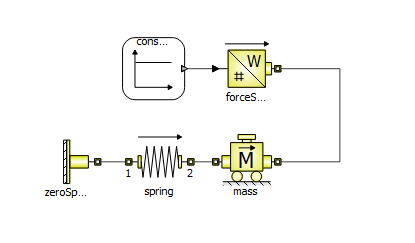
In this example a positive signal produces compression of the spring.
Translational Library
Sign convention
The positive direction of movement is defined by the orientation of the mass.
Some elements need a parameter to tell them if they are concordant or discordant with respect to the mass. This parameter is direction and to be set you need to refer to the arrow or arrows present in the component's icon:
- +1 if it is concordant to the mass
- -1 if it is discordant to the mass
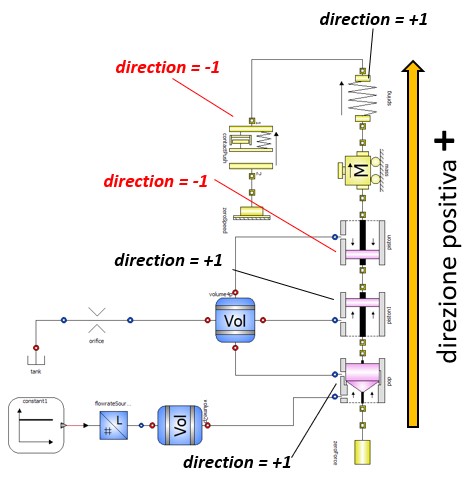
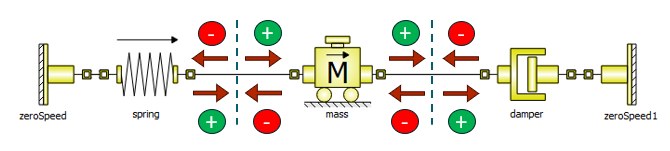
A mass that receives positive forces, regardless of whether posteriorly or anteriorly, undergoes positive acceleration. Refer to the image for the sign convention.
Compatibility with Modelica
This convention has been taken equal to the Mechanics library of the Modelica Standard Library. In this way the blocks of the two libraries can be used together.
Rotational Library
Sign convention
Regarding the rotational library the convention is:
- positive torques cause positive accelerations
there is no distinction between the pins, left and right.
This package collects few essential components to interface with the systems library. An enrichment of components is foreseen in the future.